Social Learning Platform Analysis
Platform Choice
Social learning platforms are online platforms that combine learning and social media. This creates an environment where learners can engage with information online and other peers similarly to how they would in a physical space. YouTube has become one of, if not the most, well known social learning programs through all generations. If you need a tutorial for anything one of the first places you will likely check is going to be YouTube. I chose YouTube for this assignment because of how well known it is and since it is the social learning platform I engage with the most. I enjoy that YouTube is visual and auditory, I feel like this really improves my learning on the app.
Framework
I am evaluating YouTube using the SECTIONS model by Bates (2015). SECTIONS stands for: Students, Ease of use, Costs, Teaching functions, Interaction, Organisational issues, Networking, Security and privacy. To keep this concise I decided to choose four criteria from the model that I thought were most important. The criteria I chose were students, ease of use, teaching functions, and interaction. For students I am going to be seeing how accessible YouTube is for its users. I am going to evaluate it based on the ideas brought in by Universal Design for Learning (UDL) about their educational framework developed by CAST (2024). For ease of use I am going to see how easy YouTube is for beginners to use. For this I am also going to think about the UDL’s educational framework as well. For teaching functions I am going to see how well YouTube supports its users’ learning. By looking at different multimedia learning principles we can see how well YouTube is supporting its learners. For interaction I am going to see how well YouTube allows learners and educators to interact with the concepts. I am going to think about the ideas that were brought in about oral and text-based communication by Garrison et al. (2000).
Evaluate & Analyze
Students
I think YouTube does a good job at supporting its users (in this scenario the students). Since it’s so widespread there are many different videos talking about the exact same thing but meant for many different skill levels. YouTube is increasingly accessible across all ages and skill levels.YouTube has many built in tools that make it easier for students to engage with their videos. Tools like: pausing, replaying, captions, and speeding up/slowing down, it’s easy for many different people to learn from these videos.
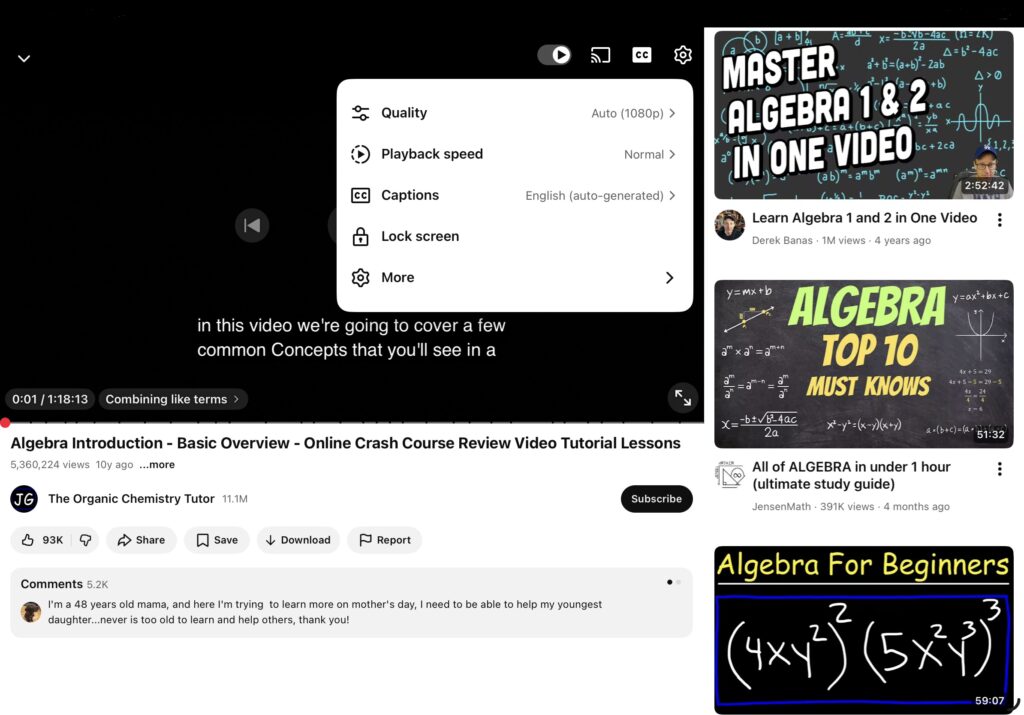
(Screenshot showing all the tools users have to help make watching videos accessible)
Ease of use
I think YouTube is relatively simple to use for both students and educators. Students can easily make a quick search and come across thousands of videos explaining the topic they are interested in. YouTube is extremely intuitive for its users, the controls are extremely easy and familiar to most. YouTube is not something that you will spend much time learning how to use. I opened YouTube and signed out to see what a new user would see and it was extremely simple to get started. It was a mainly blank page that said “try searching to get started” with a search box directly above it. This makes it extremely user friendly for new users to get started.
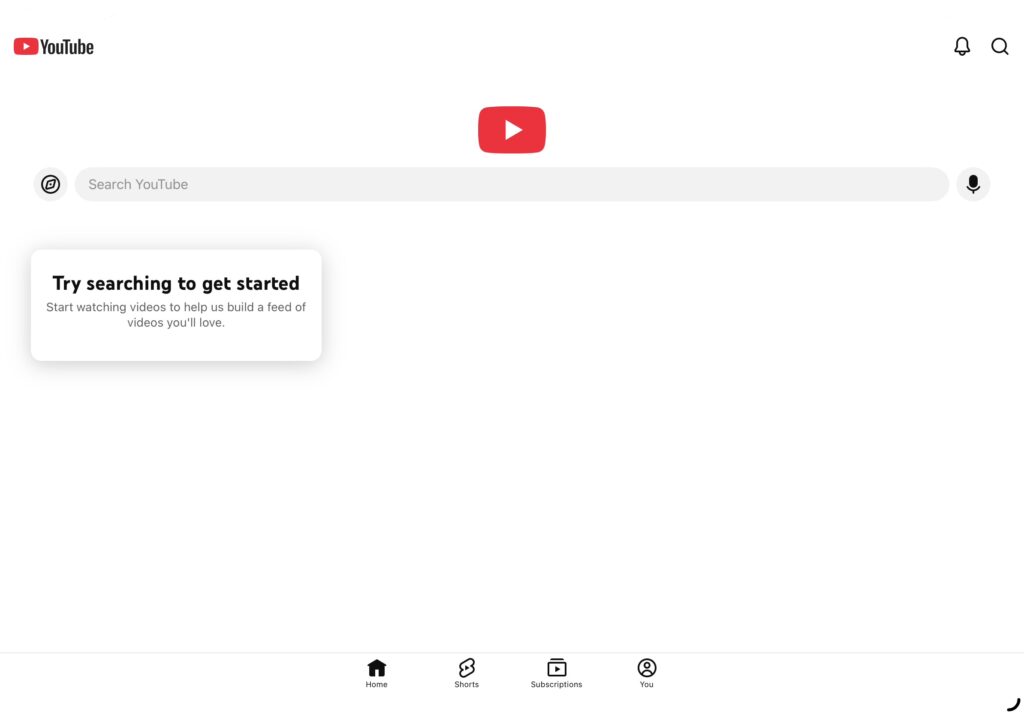
(Screenshot showing what happens when you open YouTube as a new user)
Teaching functions
As mentioned in the students sections YouTube does a pretty good job at supporting its users within their learning. Segmenting is a multimedia learning principle that YouTube does especially well. As stated in Bates (2015) “several ‘YouTube’ length videos are more likely to work better than a 50 minute video”. YouTube is made for this, users can break up their learning into shorter, more manageable pieces across a period of time rather than trying to understand a complex concept all in one go. Even if the video is an hour long you can still pause and come back right where you were once you feel like you’ve understood or had a learning break. YouTube has this feature called “chapters” where educators can segment their videos into different parts leading to perfect break points within users learning.
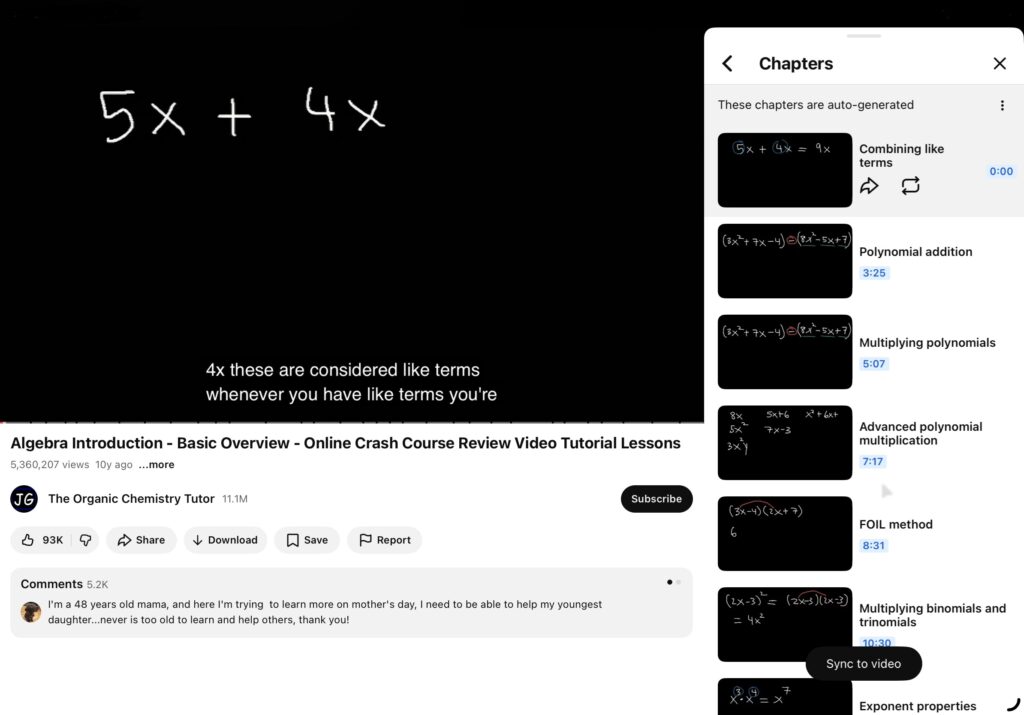
(Screenshot from “The Organic Chemistry Tutor” that shows the chapters feature)
Another multimedia learning principle that YouTube does well is the split attention principle. In research by Mousavi (1995) it was found that presenting visual and auditory information (mixed-mode) rather than all through text (single-mode) led to the best learning outcomes. YouTube demonstrates this principle perfectly, videos almost always include both visual and auditory input within them.
Interactions
YouTube does not do very well regarding interactions. Yes there is a comment section but it’s not live and may take a while for someone to respond to a comment (if they ever do). And if someone other than the creator of the video were to respond to your comment, how do you trust that you can believe what they said to be true? Lots of time comments sections are full of spam or unhelpful comments. In one of the screenshots I’ve shown below someone asked a question about the math they were learning and they got a response a month too late that was rude and entirely unhelpful. This lack of real time interaction is really the only thing that sets YouTube back. Lack of feedback can make learning a lot harder, if you have a question along the way there are very few ways to get the quick feedback that you need from the person presenting the information to you. But sometimes you can have a great learning experience in the comment section. Like in the screenshot I showed below, someone asked for help understanding the concept and someone was able to help them in a way that they understood better than the original video.
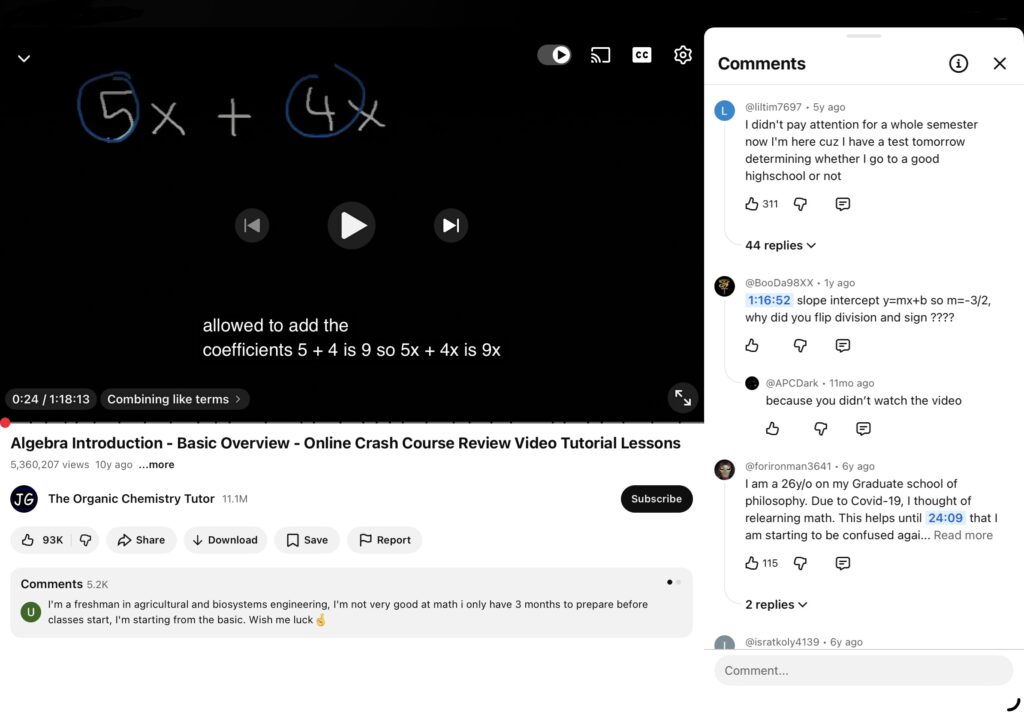
(Another screenshot from “The Organic Chemistry Tutor” that shows people don’t always get helpful answers fast enough to help through YouTube comments)
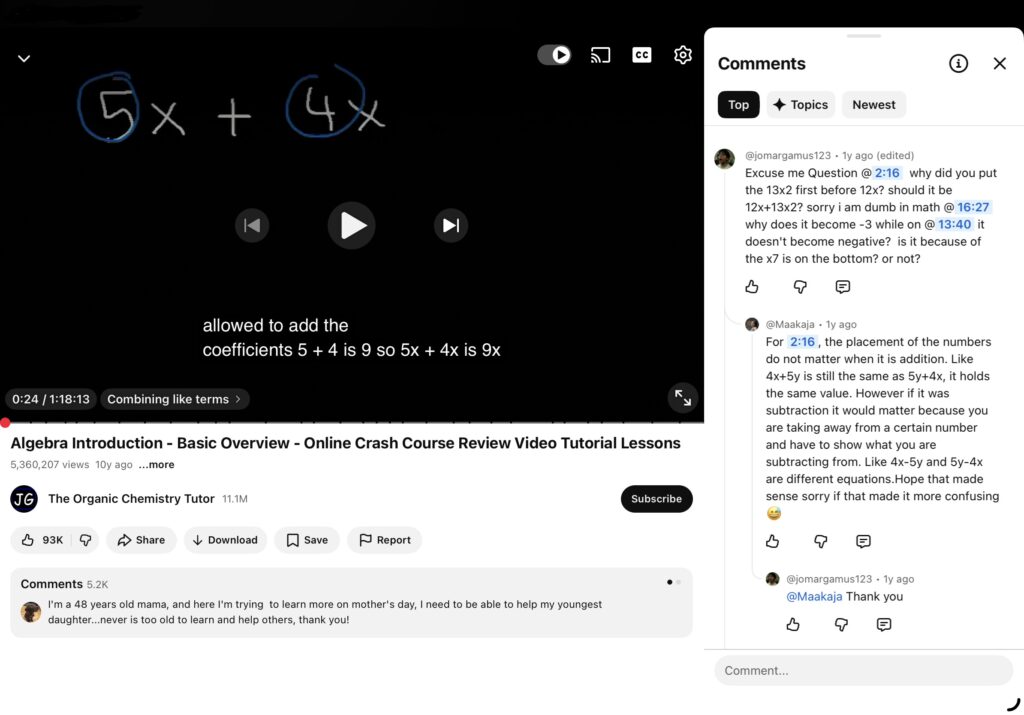
(Another screenshot from “The Organic Chemistry Tutor” that shows people interacting and helping each other through YouTube comments)
Consider the Learner
The person posting the video does typically benefit most from the platform as they are able to make money off it. This means that sometimes they do not put a lot of research into what they are saying since they are just trying to get lots of videos out in a short amount of time to be able l to make the most money they can. Most learners will benefit from YouTube as well, they are able to have all of this knowledge available whenever they are ready for it. Youtube is also free so most people are able to access it without worrying about an underlying cost. Learners also benefit because it is a space for auditory and visual learners which most learners find the most success with. YouTube shares the similar exclusions and disadvantages as all social learning platforms since they are all digital and involve technology. These include: people unfamiliar with technology, people who are visually impaired or deaf, people without internet access, etc. YouTube may also be difficult for learners with distracted attention as it is made for users to spend as much time on the app as possible. This leads to it being incredibly distracting for users.
References
Bates, A. W. (2015). Chapter 8: Choosing and using media in education: the SECTIONS model. Teaching in a Digital Age. https://opentextbooks.uregina.ca/teachinginadigitalagev2/part/9-pedagogical-differences-between-media/
CAST. (2024). The UDL guidelines. https://udlguidelines.cast.org/
Garrison, R., Anderson, T., & Archer, W. (2000). Critical Inquiry in a Text-Based Environment: Computer Conferencing in Higher Education. The Internet and Higher Education, 2(2–3). https://doi-org.ezproxy.library.uvic.ca/10.1016/S1096-7516(00)00016-6
Mousavi, S. Y., Low, R., & Sweller, J. (1995). Reducing cognitive load by mixing auditory and visual presentation modes. Journal of Educational Psychology, 87(2), 319–334. https://doi.org/10.1037/0022-0663.87.2.319